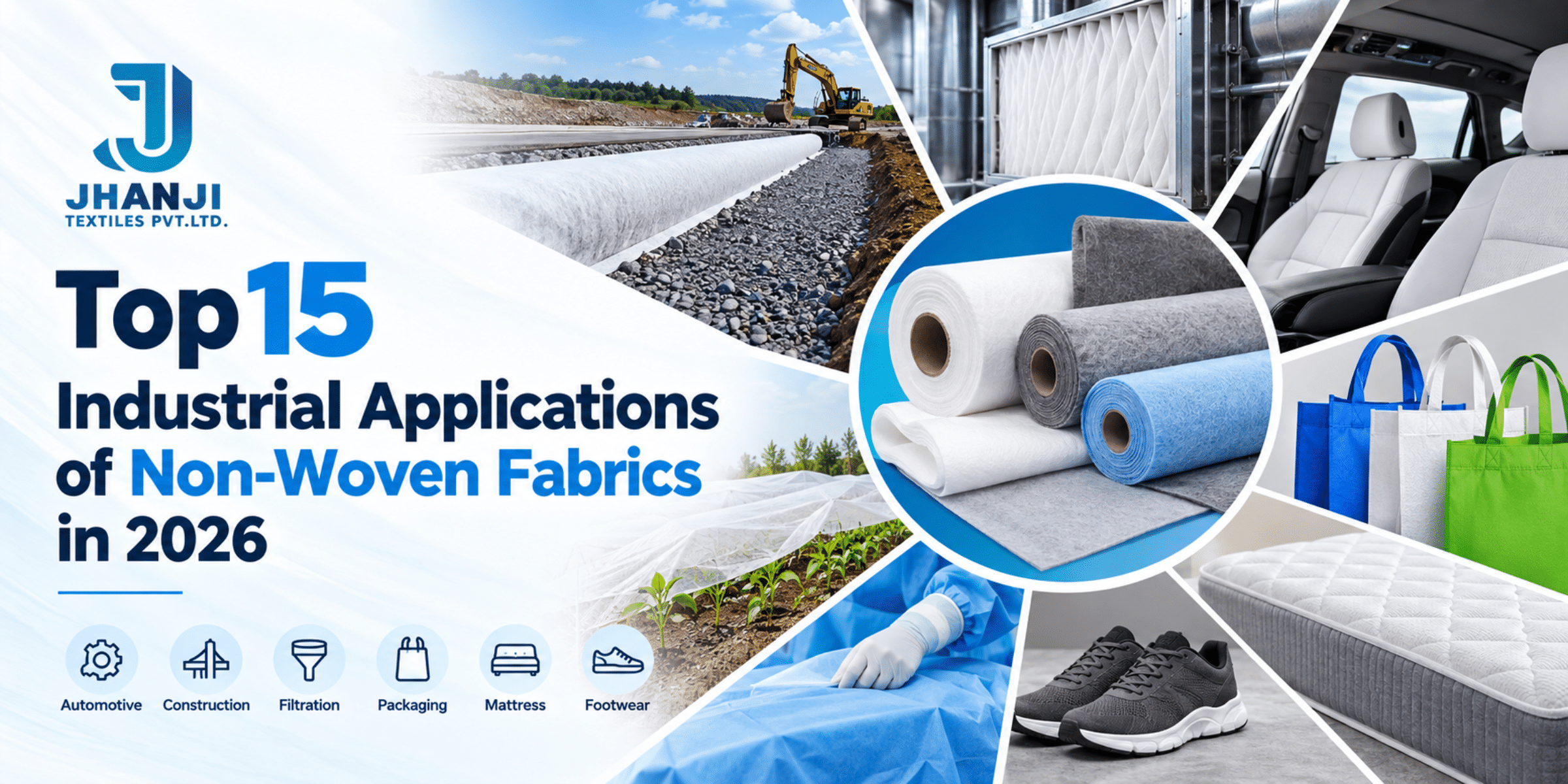
Imagine a road that stays stable for longer, a filtration system that captures unwanted particles, or a car interior that feels quieter and more comfortable. What connects these products? In many cases, it is a versatile material working behind the scenes: non-woven fabric.
From construction and automotive manufacturing to filtration, packaging, footwear, and home furnishings, non-woven fabrics have become an important part of modern industrial production. Their versatility comes from the ability to engineer specific properties, including strength, thickness, flexibility, absorbency, and filtration performance, according to the intended application.
As industries continue to focus on material efficiency, product performance, and more responsible manufacturing, understanding the right non-woven fabric for each application is increasingly important in 2026.
In this guide, we explore the top 15 industrial applications of non-woven fabrics in 2026, their practical benefits, and what businesses should consider when selecting materials for their production requirements.
What Are Non-Woven Fabrics?
Non-woven fabrics are textile materials made by bonding or entangling fibres and filaments without the traditional weaving or knitting process. Depending on the manufacturing method, the fibres may be bonded through heat, mechanical action, or suitable chemical binders.
Unlike conventional woven textiles, non-woven materials can be developed for specific functional requirements. Manufacturers can adjust factors such as fabric weight, thickness, tensile strength, softness, porosity, and surface finish.
Common types of non-woven fabrics include:
- Spunbond non-woven fabric: Often used for lightweight, durable applications such as packaging and protective covers.
- Needle-punched non-woven fabric: Suitable for applications requiring bulk, cushioning, filtration, or mechanical strength.
- Thermally bonded non-woven fabric: Produced using heat to bond fibres and create a consistent material structure.
- Spunlace non-woven fabric: Made by entangling fibres with high-pressure water jets, commonly used in wipes and cleaning applications.
- Meltblown non-woven fabric: Features fine fibres that can provide effective filtration when engineered for the required performance.
The right option depends on the intended use, operating environment, performance specifications, and budget.
Top 15 Industrial Applications of Non-Woven Fabrics in 2026
1. Filtration Systems
Filtration is one of the most important industrial applications of non-woven fabrics. Manufacturing plants, commercial buildings, water treatment facilities, and industrial equipment all require effective ways to separate unwanted particles from air or liquids.
Non-woven filtration fabrics can be designed with specific pore structures, fibre compositions, thicknesses, and permeability levels to suit different filtration requirements.
Common applications include:
- Industrial dust collection systems
- Air conditioning and HVAC filters
- Industrial filter bags
- Liquid filtration systems
- Dust and particle control equipment
Needle-punched and other engineered non-woven materials are used in different filtration systems depending on the required efficiency, pressure drop, chemical compatibility, and operating conditions.
For businesses sourcing filter media, selecting the correct material can help support consistent filtration performance and dependable equipment operation.
2. Construction and Geotextiles
Construction projects require materials that help manage soil, water, and ground stability. Non-woven geotextile fabrics are widely used in civil engineering because they can provide separation, filtration, and drainage functions.
When correctly specified and installed, these materials help prevent fine soil particles from entering drainage layers while allowing water to pass through.
Typical applications include:
- Road and highway construction
- Drainage systems
- Railway infrastructure
- Landscaping projects
- Retaining walls
- Erosion control applications
For example, a non-woven geotextile placed between soil and a drainage aggregate can help maintain separation and reduce the movement of fine particles into the drainage layer.
Fabric selection should consider tensile strength, puncture resistance, permeability, soil conditions, and installation requirements.
3. Automotive Manufacturing
Modern vehicles use a variety of technical textile components to improve comfort, reduce unwanted noise, and protect interior surfaces. Non-woven fabrics are especially useful where manufacturers need lightweight materials that can be shaped or converted into specific components.
Common automotive applications include:
- Carpet backing and trunk liners
- Interior trim and headliner components
- Acoustic insulation
- Seat backing and cushioning layers
- Protective liners and selected filtration components
Needle-punched polyester and other engineered non-woven fabrics can provide a useful combination of durability, flexibility, and sound absorption.
The benefits depend on the fabric construction and its intended role. Automotive manufacturers should evaluate abrasion resistance, temperature tolerance, odour requirements, flammability, and dimensional stability before choosing a material.
4. Packaging and Protective Wrapping
Packaging is another major application of non-woven fabrics, particularly when products need lightweight protection during storage, handling, or transportation.
Non-woven packaging materials can offer flexibility, surface protection, and opportunities for printing or converting into different product formats.
Industrial uses include:
- Protective wrapping for manufactured goods
- Reusable shopping and promotional bags
- Packaging for textile and apparel products
- Protective covers for selected components
- Linings and separators for sensitive products
Businesses may choose non-woven materials to help protect surfaces from scratches, dust, and handling damage. Their suitability depends on the product being packed and the required level of protection.
When evaluating non-woven packaging, consider material strength, thickness, printability, reuse requirements, and end-of-life disposal options. Not every non-woven fabric is recyclable or biodegradable, so sustainability claims should be verified for the specific material.
5. Footwear and Shoe Manufacturing
Footwear production relies on materials that provide structure, comfort, dimensional stability, and reliable performance. Non-woven fabrics are used in several shoe components where consistent thickness and flexibility are important.
Typical applications include:
- Shoe lining materials
- Insole support layers
- Reinforcement components
- Interlining for selected footwear parts
- Synthetic leather backing
Depending on the construction, non-woven fabrics can help manufacturers create lightweight components with the required stiffness, softness, or resistance to deformation.
For shoe manufacturers, the right fabric should be selected according to the shoe design, adhesive compatibility, moisture exposure, abrasion requirements, and expected product lifespan.
6. Mattress Manufacturing and Bedding
A mattress contains more than its visible outer fabric and cushioning layers. Supporting materials are essential for maintaining the structure, protecting internal components, and improving the overall finish.
Non-woven fabrics are widely used in mattress and bedding production because they can be manufactured in different weights, thicknesses, and strengths.
Common applications include:
- Mattress backing and base layers
- Inner covers and protective linings
- Padding support materials
- Bedding components
- Dust covers for upholstered products
A suitable non-woven fabric can help protect internal mattress components and support efficient manufacturing.
Mattress producers should consider tear resistance, dimensional stability, softness, breathability, and compatibility with the materials used in the finished product.
7. Furniture Upholstery and Cushioning
Furniture manufacturers need materials that combine appearance, functionality, and cost efficiency. Non-woven fabrics often serve as supporting layers that are not directly visible in the finished furniture.
Applications include:
- Sofa and chair dust covers
- Upholstery backing
- Cushion support layers
- Furniture lining materials
- Protective inner covers
These materials can help create a neat finish, cover internal structures, and support consistent product assembly.
The appropriate fabric depends on the furniture design, required strength, stretching characteristics, and expected wear. For furniture intended for commercial environments, durability and resistance to handling are particularly important.
8. Acoustic Insulation and Sound Absorption
Noise control has become an important consideration in vehicles, commercial buildings, industrial facilities, and equipment enclosures.
Certain non-woven fabrics, particularly porous fibrous materials, can absorb sound by reducing the energy of sound waves as they travel through the material structure.
Common applications include:
- Automotive acoustic liners
- Machinery enclosures
- Acoustic wall panels
- Sound-absorbing interior components
- Insulation layers in selected equipment
Needle-punched felt and other engineered non-woven materials may be used where sound absorption, flexibility, and convenient fabrication are required.
However, acoustic performance varies with thickness, density, fibre structure, mounting method, and frequency range. Manufacturers should evaluate tested acoustic performance rather than selecting fabric based on thickness alone.
9. Garment Interlining and Apparel Manufacturing
Non-woven fabrics are also used in garment production, particularly as interlining materials that help clothing maintain its intended shape.
An interlining is a supporting layer incorporated into a garment to provide body, stability, or reinforcement.
Typical applications include:
- Shirt collars and cuffs
- Jacket fronts
- Waistbands
- Plackets and selected garment components
- Reinforcement for structured clothing
Non-woven interlinings can help manufacturers achieve consistent results and simplify cutting and garment assembly.
The correct material depends on the outer fabric, desired stiffness, washing conditions, bonding method, and garment construction. Compatibility testing is especially important for fusible interlinings.
10. Hygiene and Medical Products
The healthcare and personal hygiene industries use non-woven fabrics in products where softness, cleanliness, fluid management, or barrier performance is required.
Different non-woven structures can be engineered for different functions, but medical suitability must be established through appropriate testing and manufacturing controls.
Applications include:
- Surgical gowns and drapes
- Medical caps and shoe covers
- Disposable examination products
- Hygiene product layers
- Selected wound-care and absorbent products
Spunbond, meltblown, spunlace, and multilayer non-woven structures serve different purposes. For example, a material designed for absorbency is not automatically suitable as a protective barrier.
Medical and hygiene manufacturers must verify applicable regulatory requirements, biocompatibility where relevant, cleanliness, barrier performance, and other product-specific standards before using a fabric in a regulated application.
11. Agriculture and Crop Protection
Agriculture is another area where non-woven fabrics can offer practical benefits. Lightweight crop covers and related materials are used to help manage environmental exposure and support crop production.
Common applications include:
- Frost protection covers
- Crop protection sheets
- Nursery plant covers
- Weed-control fabrics
- Selected horticultural protection products
Depending on the material design, a crop cover can help reduce exposure to certain weather conditions while allowing appropriate levels of air and moisture exchange.
Farmers and agricultural suppliers should consider UV resistance, water permeability, fabric weight, crop requirements, and expected outdoor service life. The best choice depends on local growing conditions and the intended agricultural use.
12. Industrial Dust Collection and Equipment Protection
Industrial production environments often generate dust and airborne particles that must be managed to protect equipment and maintain suitable workplace conditions.
Non-woven fabrics are used in dust collection systems and selected protective applications because their fibre structure can be tailored for different separation and mechanical requirements.
Applications include:
- Industrial dust collector bags
- Filter sleeves
- Protective equipment covers
- Dust-control components
- Selected ventilation filtration systems
The fabric must be matched to the operating temperature, particle characteristics, moisture levels, chemical exposure, and cleaning method.
For dust collection, filtration efficiency is only one consideration. Air permeability, resistance to abrasion, pressure drop, and the ability to withstand repeated cleaning may also affect system performance.
13. Synthetic Leather and Leather Goods
Non-woven fabrics can serve as supporting substrates in synthetic leather and selected leather-goods applications. These layers help provide the foundation on which coatings or finishing materials may be applied.
Common applications include:
- Synthetic leather backing
- Handbag and accessory components
- Selected upholstery substrates
- Reinforcement layers
- Material support for converted leather products
Depending on the construction, a non-woven substrate can help provide flexibility, uniformity, and the required physical characteristics for downstream processing.
Manufacturers should evaluate tensile strength, elongation, coating compatibility, surface finish, and resistance to repeated flexing when selecting non-woven fabric for synthetic leather applications.
14. Wall Coverings, Decoration, and Interior Finishing
Non-woven materials are used in selected interior decoration products because they can provide a consistent backing, dimensional stability, and suitability for further processing.
Applications include:
- Wall-covering substrates
- Decorative fabric backing
- Interior lining materials
- Selected laminated decorative surfaces
- Components used in interior finishing
The performance of these materials depends on their composition, surface characteristics, and compatibility with coatings or adhesives.
For commercial interiors, product developers should also consider cleanability, fire-performance requirements, dimensional stability, and the conditions in which the finished material will be installed.
15. Industrial Linings, Separators, and Specialty Components
Beyond familiar consumer products, non-woven fabrics support a wide range of industrial manufacturing processes. In many cases, they are selected because a production line needs a consistent, flexible, or easily converted sheet material.
Potential applications include:
- Protective interleaving between components
- Industrial product linings
- Cushioning and separation layers
- Selected filtration and absorption components
- Fabric substrates for lamination and conversion
The key advantage is flexibility in material design. Manufacturers can select fibre composition, weight, thickness, bonding method, and finishing according to the intended function.
For specialist applications, working with an experienced non-woven fabric supplier can help businesses identify suitable specifications and avoid choosing a material based only on price.
Key Benefits of Non-Woven Fabrics for Industrial Applications
Why do manufacturers use non-woven fabrics across so many industries? The answer is their ability to combine useful physical properties with adaptable manufacturing options.
1. Application-specific performance
Non-woven fabrics can be designed for strength, absorbency, filtration, cushioning, breathability, or surface protection. Not every fabric offers all these benefits; the material must be engineered for its intended purpose.
2. Lightweight construction
Many non-woven materials provide useful functionality without adding excessive weight. This can be valuable in automotive interiors, packaging, footwear, and other products where weight matters.
3. Flexible manufacturing options
Non-woven materials are available in different weights, widths, thicknesses, fibre compositions, and finishes. This flexibility supports a wide range of industrial product designs.
4. Efficient processing
Depending on the material and production process, non-woven fabrics can be cut, laminated, bonded, moulded, or converted into components. Their suitability depends on the requirements of the manufacturing line.
5. Potential cost efficiency
The right non-woven fabric can help businesses balance material performance, production efficiency, and total product cost. The lowest-priced material is not always the most economical if it causes waste, processing problems, or premature product failure.
How to Choose the Right Non-Woven Fabric for Your Industry
Choosing a suitable industrial non-woven fabric involves more than comparing prices. Buyers should start with the actual job the fabric needs to perform.
Consider these important factors before placing a bulk order:
- Application: Define whether the fabric will be used for filtration, cushioning, construction, packaging, footwear, or another purpose.
- Fibre composition: Select a material compatible with the intended environment and performance requirements.
- GSM and thickness: Check the required fabric weight and thickness for the finished product.
- Strength and elongation: Review tensile strength, tear resistance, and stretching requirements where relevant.
- Air and water permeability: Particularly important for filtration, geotextiles, and agricultural products.
- Temperature and chemical resistance: Essential for demanding industrial environments.
- Finishing and conversion: Confirm whether the material needs coating, lamination, printing, adhesive bonding, or other processing.
- Quality consistency: Ask about production tolerances, testing procedures, and batch-to-batch consistency.
- Compliance requirements: Verify any standards or certifications required for the specific end use.
- Supply capability: Discuss minimum order quantities, available widths, lead times, and repeat-order requirements.
A clear specification helps both the buyer and supplier determine whether a material is suitable before production begins.
Why Choose Jhanji Textiles for Non-Woven Fabric Requirements?
Finding the right material is an important step in developing a reliable industrial product. Businesses need a supplier that understands how fabric specifications affect processing, finished-product quality, and end-use performance.
Jhanji Textiles provides non-woven fabric solutions for a range of applications, including filtration, upholstery, footwear, mattresses, packaging, and other textile-related uses.
The company highlights its experience in the non-woven industry and its ability to customise material specifications such as fabric weight, tensile strength, and elongation according to customer requirements.
Whether you are developing a new product or sourcing materials for an established manufacturing process, discuss your application, target specifications, and expected order volumes with the team to identify an appropriate solution.
Explore the Jhanji Textiles website to learn more about its non-woven fabric solutions, or visit the About Us page for additional company information.