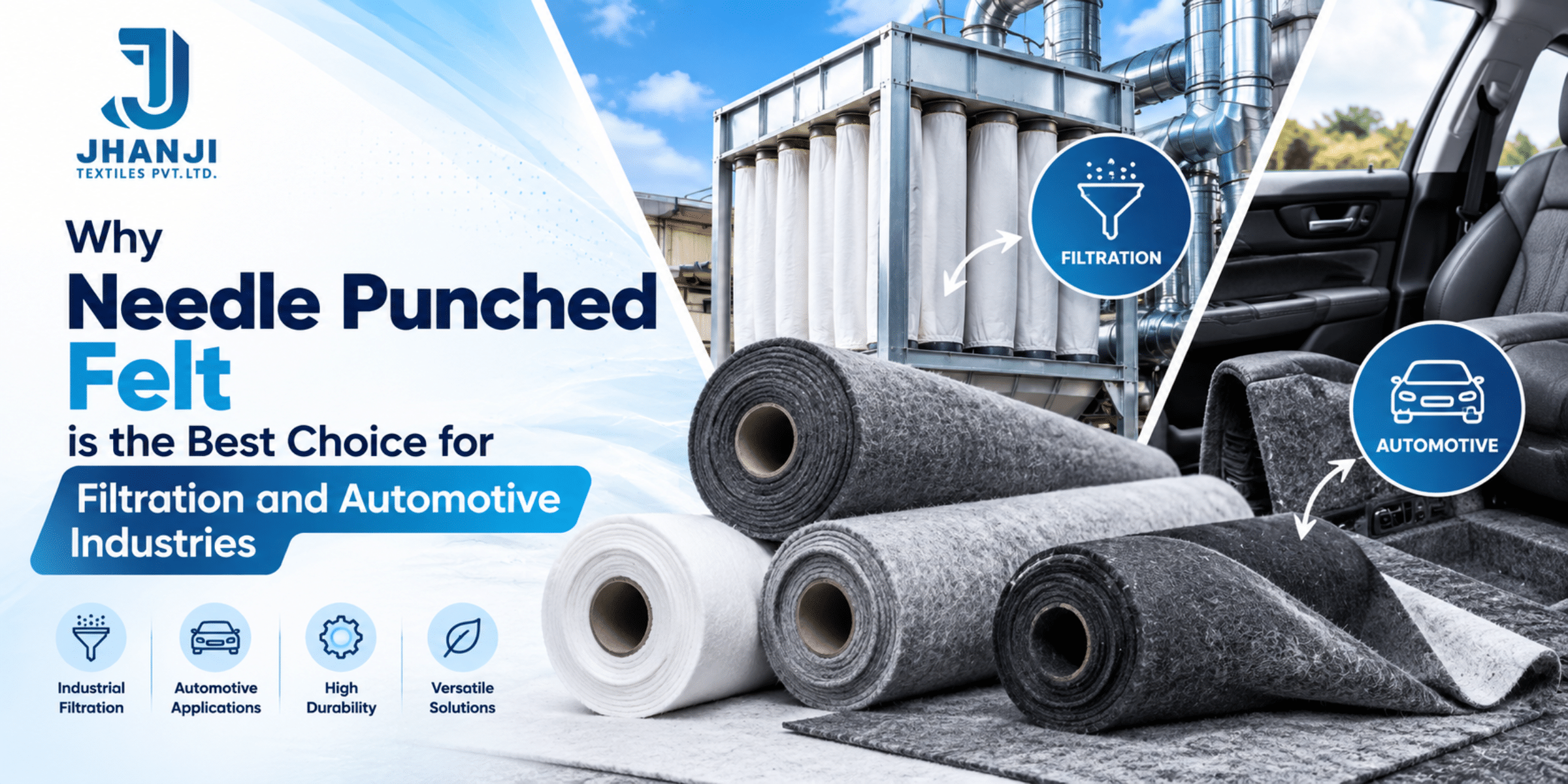
Have you ever wondered what helps industrial filtration systems capture dust or makes vehicle interiors quieter and more comfortable? In many applications, the answer lies in a versatile technical textile known as needle punched felt.
From industrial filter media to automotive carpets, acoustic insulation, and interior components, needle punched felt plays an important role in modern manufacturing. Its mechanically entangled fibre structure offers a useful combination of strength, thickness, flexibility, and functional performance.
For manufacturers, choosing the right material is not just about cost. It is about finding a solution that meets application requirements, performs consistently, and supports efficient production.
In this article, we explore why needle punched felt is a preferred material for filtration and automotive applications, its key benefits, and how to select the right specification for your business.
What Is Needle Punched Felt?
Needle punched felt is a type of non-woven fabric manufactured by mechanically entangling fibres using specially designed barbed needles. Unlike woven fabrics, which are made by interlacing yarns, needle punched felt develops its structure through the interlocking of fibres.
During manufacturing, fibres are prepared, formed into a web, and passed through a needle-punching process. The needles repeatedly penetrate the web, entangling the fibres to create a stable fabric structure.
The finished material can be engineered in different weights, thicknesses, densities, and fibre compositions to suit specific applications.
Common applications of needle punched felt include:
- Industrial air and dust filtration
- Automotive interior components
- Acoustic insulation and sound absorption
- Carpet backing and trunk liners
- Furniture upholstery and cushioning
- Footwear and synthetic leather backing
- Selected industrial and technical textile applications
The performance of the finished fabric depends on the fibre type, manufacturing parameters, finishing treatments, and intended end use.
Why Is Needle Punched Felt Ideal for Industrial Filtration?
Industrial filtration systems operate in challenging environments where the filter media must balance filtration efficiency, airflow, mechanical strength, and service life.
Needle punched felt is widely used in filtration because its three-dimensional fibre structure can be engineered to support particle capture while maintaining suitable airflow.
Let’s look at its key advantages.
1. Effective Particle Capture
Industrial filtration involves removing dust and unwanted particles from air or other process streams. Needle punched felt provides a complex network of fibres and pores that can help capture particles as the fluid passes through the material.
The actual filtration efficiency depends on fibre characteristics, fabric construction, surface treatment, particle size, and the design of the filtration system.
For manufacturers, selecting the right needle punched filtration fabric can help meet the required filtration performance without creating unnecessary resistance to airflow.
2. Suitable Air Permeability
Air permeability is an important consideration when selecting industrial filter media. A filter must allow air to pass through while capturing the targeted particles.
Needle punched felt can be manufactured with different thicknesses, densities, and pore structures to achieve the required balance between airflow and filtration.
The correct specification depends on the equipment design, operating conditions, and required filtration efficiency.
3. Mechanical Strength and Durability
Industrial filter media may be exposed to continuous airflow, dust loading, mechanical cleaning, vibration, and repeated operating cycles.
A properly engineered needle punched felt can provide the mechanical strength and structural stability needed for its intended filtration application.
Fibre selection and fabric construction play an important role in determining tensile strength, abrasion resistance, and resistance to deformation.
For businesses operating industrial filtration systems, choosing suitable filter media can help support dependable operation and reduce avoidable material replacement.
4. Customisable Fabric Specifications
Every filtration application has different requirements. A material used in a general dust collection system may not be suitable for a process involving elevated temperatures, moisture, or aggressive chemicals.
Needle punched felt can be developed using different fibre types and fabric specifications to suit particular operating conditions.
Important parameters include:
- Fabric weight, measured in GSM
- Thickness and density
- Fibre composition
- Air permeability
- Tensile strength and elongation
- Temperature and chemical compatibility
- Surface treatments, where required
For demanding applications, the fabric should be selected using actual operating conditions and relevant performance testing.
5. Potential for Efficient Long-Term Operation
The right filter media can contribute to consistent filtration performance and manageable maintenance requirements.
However, service life depends on several factors, including dust characteristics, operating temperature, humidity, cleaning cycles, and the compatibility of the filter material with the process.
Selecting needle punched felt according to these requirements can help businesses balance filtration performance, maintenance needs, and total operating costs.
Why Is Needle Punched Felt Important in the Automotive Industry?
The automotive industry uses a wide range of non-woven materials in both visible and hidden vehicle components. Manufacturers need materials that can support comfort, noise control, durability, and efficient component production.
Needle punched felt is particularly useful in applications where thickness, cushioning, acoustic performance, and flexibility are important.
1. Acoustic Insulation and Noise Reduction
Unwanted noise from tyres, road surfaces, engines, and vehicle vibration can affect cabin comfort.
Certain needle punched felt constructions are used as sound-absorbing materials in automotive interiors and other vehicle components.
Their porous fibre structure can help dissipate sound energy, depending on fabric thickness, density, fibre composition, and installation.
Typical applications include selected interior acoustic panels, under-carpet insulation, and other noise-control components.
The material must be tested for the required acoustic performance in its intended configuration.
2. Automotive Carpet Backing
Vehicle carpets need support to maintain their shape and provide a suitable finish.
Needle punched felt can be used as a backing layer in automotive carpet systems, helping support the carpet structure and providing a suitable base for further processing.
Depending on the design, it may also contribute to cushioning and acoustic comfort.
Manufacturers should evaluate bonding compatibility, dimensional stability, abrasion resistance, and the requirements of the finished carpet assembly.
3. Trunk Liners and Interior Trim
Boot liners, trunk coverings, and selected interior trim components require materials that are lightweight, easy to convert, and suitable for the intended environment.
Needle punched felt can be cut, shaped, and processed into different automotive components.
Its versatility allows manufacturers to select fabric specifications according to the desired thickness, surface appearance, stiffness, and durability.
4. Cushioning and Protective Layers
Certain automotive components require cushioning or a protective layer between surfaces.
Needle punched felt can be used in selected interior applications to provide bulk, cushioning, or surface separation.
Depending on the material construction, it may help reduce direct contact between components and support a better finished appearance.
The fabric should be selected according to compression behaviour, resistance to deformation, and expected service conditions.
5. Lightweight and Flexible Component Design
Vehicle manufacturers continually assess component weight, cost, and manufacturing efficiency.
Needle punched felt offers flexibility in fabric construction, allowing manufacturers to choose different fibre types, weights, and thicknesses for specific applications.
Its suitability depends on the component’s structural requirements, environmental exposure, and relevant automotive specifications.
For automotive suppliers, working with a non-woven fabric manufacturer that understands application-specific requirements can make material selection and production planning easier.
Needle Punched Felt for Filtration vs. Automotive Applications
Although both industries use needle punched felt, their material requirements can differ significantly.
| Requirement | Filtration applications | Automotive applications |
|---|---|---|
| Primary purpose | Particle capture and fluid flow | Acoustic comfort, cushioning and component support |
| Key performance factors | Filtration efficiency, permeability and strength | Sound absorption, dimensional stability and durability |
| Important specifications | Pore structure, fibre type and operating compatibility | Thickness, density, fibre composition and compression behaviour |
| Common applications | Filter media and dust collection | Carpet backing, acoustic layers and interior trim |
| Testing priorities | Filtration performance and operating resistance | Acoustic, mechanical and automotive-specific performance |
The key takeaway is simple: one fabric specification does not automatically suit both industries. The material should be engineered and evaluated according to the requirements of its intended application.
How to Choose the Right Needle Punched Felt
Whether you are sourcing material for filtration equipment or automotive components, selecting the right specification is essential.
Consider these factors before placing an order.
Define the Application
Explain exactly how the fabric will be used. Filtration media, carpet backing, and acoustic insulation have different performance requirements.
Select the Right Fibre Composition
Polyester and other fibre types may be appropriate for different applications. Consider temperature, moisture, chemicals, mechanical stress, and the required product lifespan.
Check GSM and Thickness
Fabric weight and thickness influence the physical characteristics of needle punched felt. Select specifications according to the final component design and required performance.
Evaluate Mechanical Properties
Depending on the application, tensile strength, elongation, abrasion resistance, dimensional stability, and compression behaviour may be important.
Confirm Performance Requirements
For filtration, review filtration efficiency, air permeability, and operating conditions. For automotive components, consider acoustic performance, bonding compatibility, durability, and relevant vehicle-industry requirements.
Work With an Experienced Manufacturer
A knowledgeable supplier can help you identify suitable specifications, discuss available customisation options, and determine which samples or tests are required before production.
Jhanji Textiles manufactures non-woven needle punched felt and offers non-woven material solutions for filtration and automotive applications. Its fabric specifications can be customised according to customer requirements.
Explore the needle punched fabric for filtration page and the automotive industry applications page to learn more.
Why Choose Jhanji Textiles for Needle Punched Felt?
Finding the right material partner is an important step in maintaining product quality and production consistency.
Jhanji Textiles Pvt. Ltd. manufactures non-woven fabrics, including chemical-bonded, thermal-bonded, and needle punched felt products. The company serves multiple industries, including filtration and automotive manufacturing.
Its product range and customisation capabilities can help businesses explore fabric specifications suited to different end-use requirements.
When evaluating a supplier, consider its ability to discuss your application, explain material specifications, support sample evaluation, and maintain consistency across orders.
Whether you need needle punched felt for industrial filtration or non-woven material for automotive components, share your technical requirements with the Jhanji Textiles team to discuss a suitable solution.
Visit the Jhanji Textiles to explore its products and applications.
Conclusion
Needle punched felt is a versatile technical textile that supports a wide range of filtration and automotive applications. Its mechanically entangled fibre structure allows manufacturers to develop materials with different combinations of strength, thickness, porosity, and flexibility.
In filtration, the right material can help balance particle capture, airflow, and durability. In automotive manufacturing, suitable grades can support acoustic comfort, cushioning, carpet backing, and interior component production.
The most important step is selecting a fabric that matches your actual operating conditions and performance requirements.
Looking for needle punched felt for filtration or automotive applications? Contact Jhanji Textiles to discuss your required fabric specifications, application, and customisation needs.