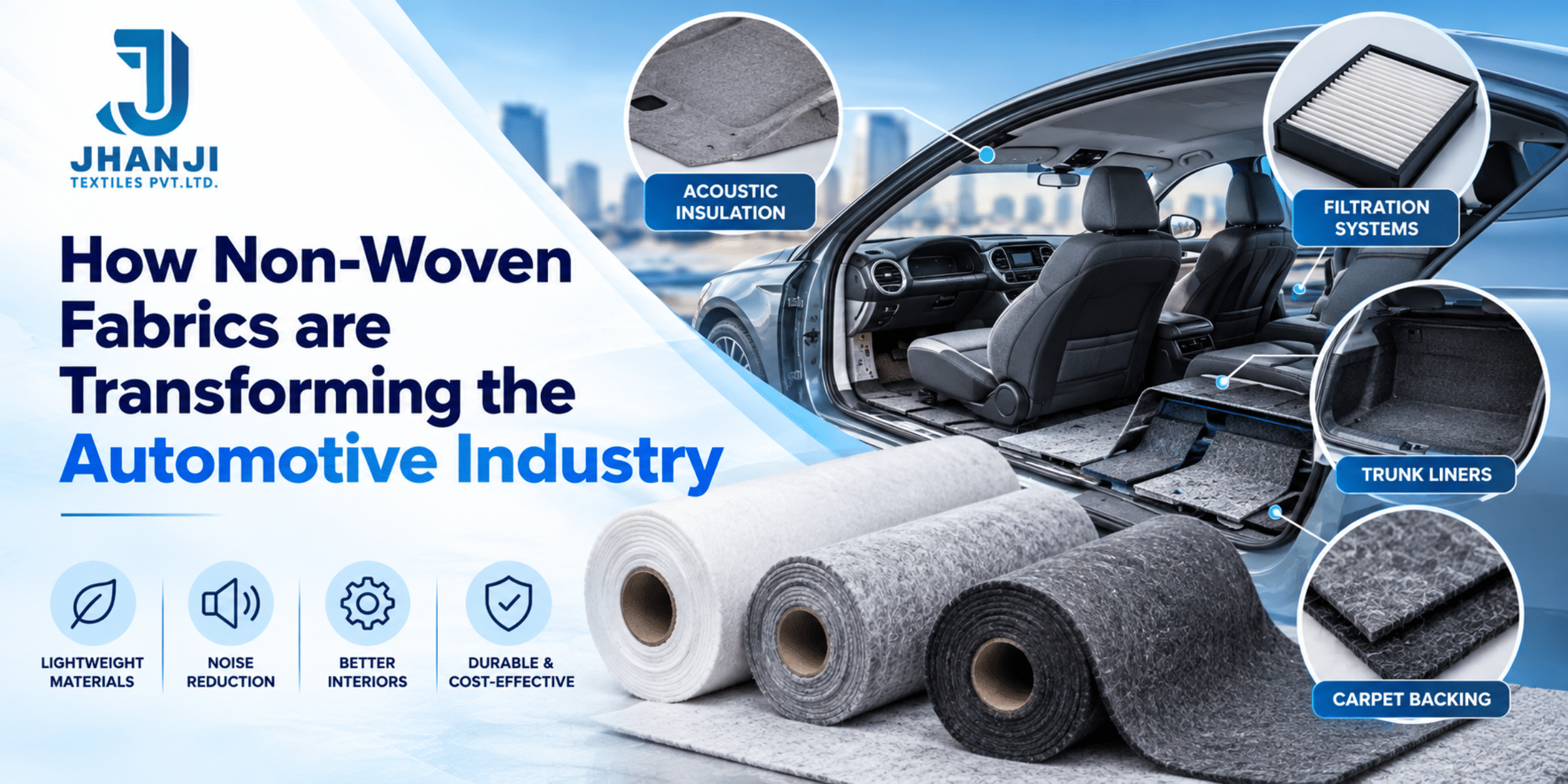
When we think about automotive innovation, we usually picture electric vehicles, advanced safety systems, smart dashboards, and fuel-efficient engines. But there is another important development happening behind the scenes: the growing use of technical textiles.
Non-woven fabrics in the automotive industry are helping manufacturers develop lighter vehicle components, improve cabin comfort, manage noise, and support effective filtration. From the carpet beneath your feet to the insulation hidden behind interior panels, these materials play an important role in modern vehicle design.
Unlike traditional woven fabrics, non-woven materials are manufactured by bonding or mechanically entangling fibres rather than weaving yarns together. This gives manufacturers greater flexibility to develop materials with specific thicknesses, strengths, densities, and functional properties.
As automotive manufacturers continue to focus on performance, comfort, manufacturing efficiency, and sustainability, non-woven fabrics are becoming increasingly valuable.
In this article, we explore how automotive non-woven fabrics are transforming vehicle manufacturing, their major applications, and what businesses should consider when choosing the right material.
What Are Non-Woven Fabrics in the Automotive Industry?
Non-woven fabrics are engineered textile materials made by bonding or entangling fibres using mechanical, thermal, or chemical processes.
In automotive manufacturing, these materials are selected for particular functions, such as sound absorption, insulation, filtration, cushioning, reinforcement, and surface protection.
Common types used in automotive applications include:
- Needle-punched non-woven felt: Produced by mechanically entangling fibres to create a flexible, porous structure. It is used in selected acoustic, interior, and protective components.
- Thermally bonded non-woven fabric: Made by bonding fibres using heat, making it suitable for various lightweight and functional components.
- Spunbond non-woven fabric: Commonly used for backing layers, protective coverings, and selected interior applications.
- Meltblown non-woven fabric: Made with fine fibres and used in filtration applications requiring carefully engineered particle-capture performance.
- Recycled-fibre non-woven fabric: Made using recycled fibres where the material properties and end-use requirements permit.
Each type serves a different purpose. The right choice depends on the component design, performance requirements, manufacturing process, and operating environment.
10 Ways Non-Woven Fabrics Are Transforming the Automotive Industry
1. Making Vehicles Lighter
Vehicle weight affects energy consumption, handling, and overall efficiency. In electric vehicles, reducing unnecessary weight can also help manufacturers manage energy use and vehicle range.
Non-woven fabrics can replace or complement heavier materials in selected interior, insulation, and trim applications.
Their low weight, combined with the ability to manufacture materials in different densities and thicknesses, makes them useful in automotive component design.
Common applications include:
- Interior trim substrates
- Carpet backing
- Trunk liners
- Insulation layers
- Selected composite reinforcement components
The actual weight reduction depends on the material being replaced and the design of the finished component. Non-wovens are not automatically lighter than every alternative, but they give manufacturers another option when optimising vehicle weight.
2. Improving Cabin Comfort Through Noise Reduction
A quiet cabin makes driving more comfortable, especially during long journeys and at highway speeds.
Road noise, tyre vibration, wind, and mechanical sounds can travel through different parts of a vehicle. Automotive non-woven fabrics are used in selected components to absorb sound and help manage unwanted noise.
Needle-punched felt is particularly relevant in applications where a porous fibre structure can provide useful acoustic absorption.
Typical applications include:
- Carpet underlays
- Door panel insulation
- Headliner backing
- Dashboard insulation
- Wheel-arch acoustic liners
- Selected engine-compartment insulation components
The acoustic performance depends on thickness, density, fibre composition, mounting method, and the frequency of the sound being controlled.
For automotive manufacturers, selecting the right non-woven acoustic material can contribute to a more comfortable driving experience.
3. Supporting Automotive Filtration Systems
Filtration is essential for protecting vehicle systems and maintaining suitable air quality inside the cabin.
Non-woven fabrics are used in different automotive filter designs because their fibre structures can be engineered to capture particles while allowing air or fluids to pass through.
Applications may include:
- Cabin air filters
- Engine air filtration
- Oil filtration
- Fuel filtration
- Other vehicle fluid and air filtration components
Different filtration technologies serve different purposes. Fine-fibre meltblown media, layered non-wovens, and other engineered filter materials should be selected according to the required filtration efficiency, airflow, pressure drop, and operating conditions.
For manufacturers, the key is to match the filtration material to the specific system rather than choosing a fabric based on appearance or thickness alone.
4. Enhancing Automotive Interior Components
Vehicle interiors combine visual appeal with practical requirements such as durability, comfort, and ease of maintenance.
Non-woven fabrics are used in many interior components, often beneath visible surfaces where they provide structural support, backing, insulation, or cushioning.
Common examples include:
- Door panel substrates
- Headliner backing
- Seat backing and reinforcement
- Interior trim layers
- Parcel shelf coverings
- Console and storage compartment linings
These materials can be engineered for specific physical properties and processed into different shapes and formats.
Their flexibility helps component manufacturers develop functional interior parts while balancing production requirements and material costs.
5. Improving Carpet and Trunk-Liner Performance
Automotive carpets and trunk liners must withstand repeated use, friction, dirt, and everyday handling.
Non-woven fabrics are widely used as primary or secondary carpet backing, underlay, and supporting layers in automotive flooring systems.
They may help provide:
- Structural support for carpet systems
- Cushioning beneath floor coverings
- Dimensional stability
- Additional acoustic absorption
- Suitable backing for component conversion
Needle-punched non-woven fabrics are useful in selected flooring and trunk applications because their construction can provide bulk and flexibility.
The right specification depends on abrasion resistance, thickness, bonding compatibility, dimensional stability, and the expected service conditions.
6. Providing Thermal Insulation
Temperature management is another important consideration in vehicle design.
Certain non-woven materials are used in selected insulation components to help limit heat transfer between vehicle areas or protect nearby components from thermal exposure.
Potential applications include:
- Dashboard insulation
- Hood and engine-compartment insulation
- Selected heat-management components
- Interior thermal insulation layers
The material must be suitable for the temperature range, moisture exposure, and other environmental conditions involved.
Automotive-grade insulation requires appropriate performance testing. A standard non-woven fabric should not be assumed to provide heat or flame resistance unless its specifications confirm this.
7. Supporting Electric Vehicle Development
Electric vehicles create new opportunities for technical textiles.
Without a conventional combustion engine, some traditional noise sources are reduced, making tyre, road, and wind noise more noticeable. Acoustic management can therefore remain important in electric vehicle design.
Non-woven materials can be used in selected EV applications, including:
- Cabin acoustic insulation
- Carpet underlays and interior trim
- Cabin air filtration
- Selected protective and separation layers
- Certain engineered battery-related components
Battery-related applications require particular care. Materials used near battery cells or electrical components must meet the relevant thermal, electrical, chemical, and safety requirements.
Non-woven fabrics are not interchangeable across all EV applications. Each component must use materials specifically designed and tested for its function.
8. Enabling Flexible Component Design
Automotive manufacturers need materials that can be adapted to different component shapes and production methods.
Depending on their construction, non-woven fabrics can be cut, laminated, moulded, bonded, coated, or combined with other materials.
This versatility supports the development of components such as:
- Moulded interior panels
- Trunk and parcel shelf liners
- Door trim substrates
- Carpet backing
- Selected reinforcement layers
The ability to tailor fabric weight, thickness, density, and composition helps manufacturers align the material with the requirements of a particular part.
For suppliers and component makers, this flexibility can make non-woven fabrics a practical option for both new designs and established production processes.
9. Supporting Cost-Efficient Manufacturing
Material cost is important, but it is only one part of the total cost of an automotive component.
Manufacturers also need to consider production speed, cutting waste, material consistency, assembly requirements, and the risk of component failure.
Non-woven fabrics can offer manufacturing advantages in applications where their properties are well matched to the production process.
Potential benefits include:
- Flexible material specifications
- Suitability for automated cutting and conversion
- Consistent thickness and weight when properly controlled
- Integration with other layers
- Efficient production of selected interior components
The final cost benefit depends on the application, material grade, equipment, and manufacturing volumes.
Selecting the lowest-priced fabric without considering performance can lead to higher costs later. Technical suitability and consistent quality should remain central to material selection.
10. Encouraging More Sustainable Material Choices
Sustainability is an increasingly important consideration for automotive manufacturers and their suppliers.
Non-woven fabrics can contribute to material-efficiency goals when they are designed for durability, incorporate suitable recycled fibres, or fit into a viable recovery or recycling process.
Potential approaches include:
- Using recycled fibres where technically suitable
- Reducing unnecessary material weight
- Designing components for longer service life
- Minimising manufacturing waste
- Evaluating material recovery at the end of a vehicle’s life
However, sustainability depends on the complete material lifecycle. Not all non-woven fabrics are recyclable, biodegradable, or environmentally preferable in every application.
Manufacturers should evaluate fibre composition, manufacturing impacts, durability, disassembly, and end-of-life options before making environmental claims.
Why Is Needle-Punched Felt Important in Automotive Manufacturing?
Among the different types of non-woven fabrics, needle-punched felt has a valuable role in selected automotive applications.
It is manufactured by mechanically entangling fibres, creating a porous structure that can be developed in different thicknesses, densities, and weights.
Depending on the fibre composition and manufacturing specifications, needle-punched felt may be suitable for:
- Automotive acoustic insulation
- Carpet backing and underlays
- Trunk liners
- Selected interior trim components
- Cushioning and protective layers
- Certain filtration and industrial applications
Its usefulness comes from the ability to tailor its physical properties to the intended application.
For example, a felt designed for acoustic absorption may require a different density and thickness from one intended for carpet backing. Similarly, filtration media must meet specific permeability and particle-capture requirements.
This is why material selection should begin with the component’s actual performance needs.
How to Choose the Right Non-Woven Fabric for Automotive Applications
Selecting an automotive non-woven fabric requires more than checking the price per square metre. The material must meet the technical requirements of the finished component.
Consider these factors before making a decision.
Fibre Composition
Polyester, polypropylene, recycled fibres, and other materials may be suitable for different applications. Choose a composition that meets the required mechanical, thermal, and environmental properties.
GSM and Thickness
Fabric weight and thickness influence the material’s physical characteristics. The right specification depends on whether the fabric is intended for backing, insulation, cushioning, filtration, or reinforcement.
Strength and Durability
Review tensile strength, tear resistance, abrasion resistance, and dimensional stability according to the application.
Acoustic and Thermal Performance
For insulation applications, evaluate the material’s tested acoustic absorption or thermal performance. Do not rely on thickness alone as an indicator of performance.
Processing Compatibility
Check whether the fabric is suitable for the required cutting, bonding, lamination, moulding, or assembly process.
Quality Consistency
Automotive component production often requires repeatable material specifications. Ask suppliers about quality controls, production tolerances, test reports, and batch consistency.
Application-Specific Compliance
Automotive components may need to satisfy requirements related to flammability, odour, emissions, temperature resistance, and other performance criteria. Confirm the relevant specifications before production.
Why Choose Jhanji Textiles for Automotive Non-Woven Fabrics?
Choosing the right textile supplier can help automotive component manufacturers find materials that meet their application requirements and production needs.
Jhanji Textiles Pvt. Ltd. manufactures non-woven fabrics, including needle-punched felt and thermal-bonded materials, for various industries, including automotive manufacturing.
The company’s automotive range includes non-woven needle-punched polyester felt, recycled-fibre needle-punched felt, speaker felt, and other non-woven materials for relevant applications.
Jhanji Textiles also highlights its ability to customise fabric specifications according to customer requirements, including fabric weight, tensile strength, and elongation.
For automotive suppliers, this provides a starting point for discussing material requirements for acoustic insulation, interior components, and other suitable applications.
Explore the automotive non-woven fabric solutions to learn more about the company’s product range.
Conclusion
Non-woven fabrics are helping transform automotive manufacturing by providing versatile material options for lighter components, improved cabin comfort, filtration, insulation, and flexible interior design.
From needle-punched felt used in carpet backing and acoustic components to engineered non-wovens used in filtration systems, these materials perform important functions throughout modern vehicles.
As automotive designs evolve, selecting the right fabric will remain essential. Fibre composition, weight, thickness, strength, processing compatibility, and application-specific testing all influence the final result.
For automotive manufacturers and component suppliers, the goal is to choose a material that balances performance, quality, and production requirements.
Looking for non-woven fabric for automotive applications? Contact Jhanji Textiles to discuss your requirements and explore suitable material options for your next project.